
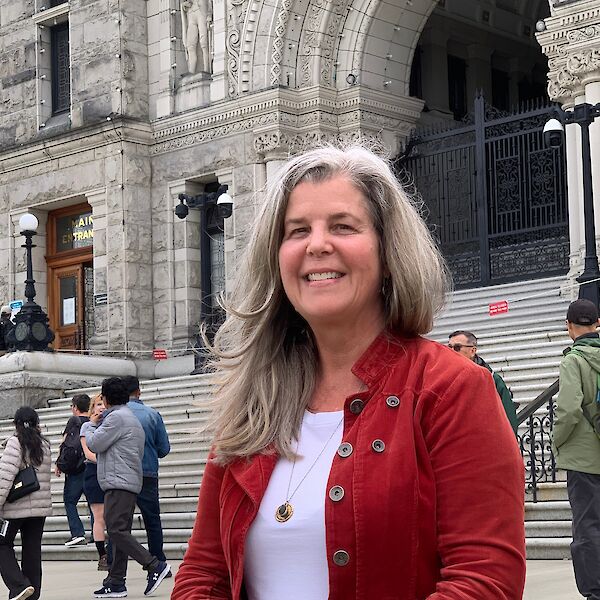
Karen Rothe
About
Policy commitments
We all want healthy, affordable, and comfortable homes. These policies will help to lower energy bills, cut pollution, and improve indoor air quality.
Our community is already experiencing the harmful impacts of climate change caused by fossil fuel pollution, and taxpayers are on the hook to upgrade and repair critical infrastructure.
The air we breathe, the water we drink, and the food we eat all rely on healthy ecosystems. Nature can also help protect our community from extreme weather by controlling floods, protecting shorelines, and cooling neighbourhoods. Access to nature improves the health and well-being of residents, and supports biodiversity.
We envision vibrant, walkable communities that protect nature and improve food security.
Connecting neighbourhoods through public transit and active transportation networks will cut pollution, improve public health, and make our communities more affordable (and fun!).
Climate change, increasing populations, and overconsumption threaten our water security. Healthy watersheds and forests are critical to support clean drinking water, stormwater management, climate resilience, and biodiversity for future generations.
Zero waste policies reduce pollution, keep waste out of landfills, build resilient local economies, and safeguard public health by shifting society away from a disposable culture toward a sustainable circular economy.
Climate action
Through my paid and unpaid work with Emergency Management BC, I have seen the results of climate change—more frequent and extreme storm events, including wildfires, floods, and droughts are now our reality. Every dollar invested in planning and preparedness saves between three to ten dollars in response. FireSmart is a good example of a successful program that is helping to save homes and communities .
Volunteer: For 22 years I managed 1936 strata. I experienced the challenges of replacing building systems and respecting the finances of the residents. I became acutely aware of the need for grant programs that support building owners and managers to “do the right thing” as responsible stewards when more environmentally responsible choices are more expensive in the short-term.
Personal: I have always chosen to live within walking or biking distance of my work. I was fortunate to be part of a family who valued and spent a great deal of time in the outdoors and was very conscious of an individual’s and group’s impact on the environment and how each person’s choice has a cumulative impact. Whether it is a building, the environment, or a community we are stewards for future generations and we should make decisions that reflect that
Questions for Victoria
1. Climate Resilience (flooding and cooling): Critical stormwater systems need to be upgraded in combination with a requirement for permeable surfaces where practicable in new construction (buildings) and during infrastructure replacement, e.g., bioswales—a work with nature approach. In short, these requirements would address above ground (tree preservation and planting), on the ground (permeable surfaces); and below ground (smart infrastructure that can accommodate extreme weather events).
2. Reducing Emissions and Waste: Transportation design; new development; capital projects; and operational and capital purchases by the City must follow as far as practicable emission reduction objectives. I will support identifying innovative solutions and grant programs that support keeping buildings out of the landfill.
3. Increasing Green Spaces: Trees and vegetation are key to ensuring a livable and prosperous as well as climate resilient community. They give our City character that translates into economic benefits and people close to green spaces have better health outcomes. I will support the creation of green spaces for new development and underserved neighbourhoods.
Balancing development and other demands with these priorities will require informed decision-making supported by credible data. Short-term gain must not be the main driver.
Trees can cut the urban heat island effect by almost 50%, which translates to a cooling effect of roughly 0.5–1.5°C. This cooling effect is particularly noticeable in hot. I support preserving trees and existing green spaces and planting new trees and creating new green spaces is critical as well as having a maintenance plan to ensure their survival as the climate changes.
Emergency Plans need to be in place, and exercised, to protect vulnerable populations. Cooling locations that are large enough to accommodate those who need them, such as libraries and recreation centres, need to be identified prior to the event. People need to have information about what to do and where to go before an event happens as well as when it happens.
Apartment building owners, homeowners, and renters need to have access to inexpensive or grant-subsidized heating and cooling system improvements. I support exploring those options under the umbrella of the Building Code and affordability, particularly for renters.
I also support heat-mapping that helps to prioritize neighbourhoods most at risk during extreme heat events, both in terms of action and budgeting the work will need to be phased.
In term of process, key areas for retention need to be identified to ensure that there is enough area for specific ecosystems to survive, particularly during a drought period. Neighbours need to be consulted about proposed changes to their green spaces; they know how they have been changing. That level of engagement will result in a better balance between development and green-space preservation and a more sustainable community overall. Engineering, public works, planning, and the community need to work together in lockstep.
Our landfill is nearing capacity. I support incentivizing the retention and retrofitting, instead of demolishing, existing homes and building new—apartments of single detached homes. Such incentives include improving the process for a homeowner to re-design their property, which often adds time and prohibitive costs to such a venture. Measurable results would be a streamlined system for processing such applications.
Congestion results in increased emissions, and integrated planning would help address that issue. I think transportation planning in the Capital Region is too ad hoc with BC Transit, Victoria Regional Transit Commission, Trandev, and a dozen municipalities with separate transportation plans. The region is becoming large enough to warrant a regional transportation authority to plan for coordinating and implement major transportation projects and delivering critical transportation services. I support Victoria taking the lead with other municipalities, the CRD, and the Province to create a regional transportation authority for the Capital Region. This would consolidate trail, road planning and public transportation under one roof, which would deliver economic benefits though the improved movement of people and goods as well as reduced emissions. Measurable results would be the decision to form a regional transportation authority and the beginning of implementation.
Compiled & presented by

Vote4Tomorrow is an independent voter guide to evaluate where local candidates stand on climate and environmental policies that will affect our future.