
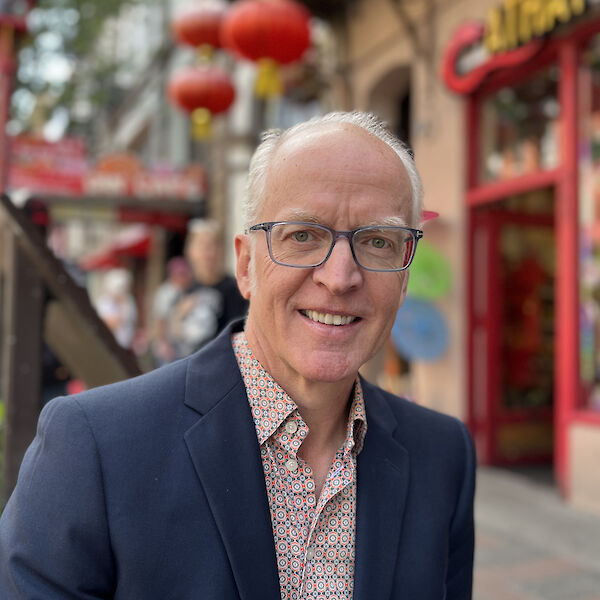
Dave Thompson
About
Policy commitments
We all want healthy, affordable, and comfortable homes. These policies will help to lower energy bills, cut pollution, and improve indoor air quality.
Our community is already experiencing the harmful impacts of climate change caused by fossil fuel pollution, and taxpayers are on the hook to upgrade and repair critical infrastructure.
The air we breathe, the water we drink, and the food we eat all rely on healthy ecosystems. Nature can also help protect our community from extreme weather by controlling floods, protecting shorelines, and cooling neighbourhoods. Access to nature improves the health and well-being of residents, and supports biodiversity.
We envision vibrant, walkable communities that protect nature and improve food security.
Connecting neighbourhoods through public transit and active transportation networks will cut pollution, improve public health, and make our communities more affordable (and fun!).
Climate change, increasing populations, and overconsumption threaten our water security. Healthy watersheds and forests are critical to support clean drinking water, stormwater management, climate resilience, and biodiversity for future generations.
Zero waste policies reduce pollution, keep waste out of landfills, build resilient local economies, and safeguard public health by shifting society away from a disposable culture toward a sustainable circular economy.
Climate action
Moved Council motions, e.g.:
- making Victoria the first city to implement Zero Carbon Step Code
- Establishing rapid bus lanes
- Connecting Victoria bike-and-roll lanes to Saanich lanes
Moved CRD board motions, e.g.:
- Directing staff to increase climate action ambition
- Directing staff to coordinate transit flow and speed improvements across municipal boundaries.
Brought, sponsored and spoke in support of UBCM resolutions calling on the province to, e.g.:
- Increase climate action funding for cities
- Enable a class action suit against oil companies for the municipal costs of climate change
- Provide cities more tools to reduce emissions from buildings.
Advocated to federal government, e.g. for electric shore power for cruise ships.
Advocated for and supported policy development at City and CRD and publicly for, e.g. more parks, trees in underserved areas of Victoria, for blue-green corridors and linear parks, reining in regional sprawl that kills forests and local food production.
Co-founded neighborhood association Climate Action Group.
Trying to bus and bike more and leave the car at home, and switched to a PHEV (next up is EV or car-free).
Questions for Victoria
1. Reducing fossil fuel burning that causes climate change - an existential threat. EVERY place must do its part. Emissions can be reduced through electrification and transportation alternatives, which I continue to advance through many policy and budget motions at Council and CRD and my own advocacy (examples in responses to other questions, and https://davethompsonvictoria.ca/welcome-and-blog-navigation/).
2. Preparing for climate impacts, which are worsening. I will continue to bring motions and advocate for adaptation, e.g. more trees, parks, green spaces (especially in urban core heat islands where populations are vulnerable) and other nature based solutions, and heat pumps, cooling stations, infrastructure hardening, managed retreat, social infrastructure, etc.
3. Education - the need to inform the public and overcome misinformation, climate denialism, action delay, fossil fuel promotion, etc.
How I respond when environmental protection is presented as conflicting with housing or economic growth includes gently pointing out facts:
1. A cleaner economy can create good, green jobs, e.g. https://columbiainstitute.eco/wp-content/uploads/2011/05/Green-Jobs-David-Thompson-UPDATED.pdf
2. New homes and economic activity can be in the right places, i.e. developed areas rather than forests or farmland, where people can meet their needs locally, e.g. https://davethompsonvictoria.ca/leveraging-regional-growth-to-mitigate-climate-change/
3. “Trees versus homes” is a false dichotomy and we can have both, as Victoria has demonstrated by adding over 8,000 homes in ten years, while growing our tree canopy by an area equal to over 100 soccer fields. Our recent OCP updates encourage more contiguous growing space for trees.
As far as specific policies and investments go, I would do the thing that is actually effective: bring a council motion directing staff to report back on status, past actions, and potential policies, costs, funding sources, and recommendations to achieve goals, and take it from there. Our Parks and Engineering staff teams are experienced and expert in these areas and related ones (infrastructure locations, etc.).
This is how it actually works in every functional city; Council sets goals (service level expectations), and staff make recommendations on how to implement it. (Council members leading with implementation ideas often get it wrong, and slow down goal achievement.)
I would continue this effective strategy, ramping up Council’s goals and expectations, calling on staff for the implementation, and approving budget dollars as needed.
For buildings, since we eliminated fossil fuel heating in new buildings (my Zero Carbon Step Code motion), we need to reduce emissions from existing buildings. We have started that work with benchmarking and monitoring and some tax reductions for clean energy system retrofits, and we have advocated to the province for regulatory options (I sponsored this resolution at UBCM). Heat pumps are cheaper to run than fossil fuel furnaces.
For transportation we need to continue our policies and investments in electrification (e.g. we require EV charging stations at new buildings, and invest in public chargers), and mode shift, e.g. my motions supporting bus lanes and transit coordination between municipalities, and expanding protective infrastructure for people who use active, low-carbon, and more affordable transportation (their feet, wheelchairs, bikes, mobility scooters and the like).
I would, as explained in the two questions above, bring a motion to direct staff to assess status and efforts to date, and provide analysis and recommendations to further this work and achieve the goals.
Campaign contributions
Public records from Elections BC — 59 contributions totalling $29,458.90.
2022 GENERAL LOCAL ELECTIONS
59 contributions · $29,458.90
| Contributor | Date | Amount | Office | Jurisdiction |
|---|---|---|---|---|
| IRENE ALLEN | Mar 29, 2022 | $1,000.00 | COUNCILLOR | VICTORIA |
| JUSTIN AYLWARD | Sep 6, 2022 | $100.00 | COUNCILLOR | VICTORIA |
| DAVID BILTEK | Aug 24, 2022 | $250.00 | COUNCILLOR | VICTORIA |
| JOSEPH CALENDA | Sep 5, 2022 | $100.00 | COUNCILLOR | VICTORIA |
| LINDA CHANG | Oct 25, 2021 | $1,239.18 | COUNCILLOR | VICTORIA |
| JAMES COCCOLA | Aug 30, 2022 | $100.00 | COUNCILLOR | VICTORIA |
| PATRICK CONN | Oct 13, 2022 | $300.00 | COUNCILLOR | VICTORIA |
| PAMELA COPLEY | Oct 6, 2022 | $150.00 | COUNCILLOR | VICTORIA |
| RAYNA CORNER | Sep 5, 2022 | $100.00 | COUNCILLOR | VICTORIA |
| LORNE DANIEL | Sep 5, 2022 | $100.00 | COUNCILLOR | VICTORIA |
| SAMANTHA DICKIE | Oct 2, 2022 | $200.00 | COUNCILLOR | VICTORIA |
| MARC-ANTOINE DUFAULT | Sep 10, 2022 | $100.00 | COUNCILLOR | VICTORIA |
| CAMERON ESLER | Aug 21, 2022 | $100.00 | COUNCILLOR | VICTORIA |
| BEN FARRIS | Aug 7, 2022 | $640.00 | COUNCILLOR | VICTORIA |
| GREG FLANNAGAN | Aug 21, 2022 | $1,250.00 | COUNCILLOR | VICTORIA |
| DONNA FREMONT | Aug 22, 2022 | $500.00 | COUNCILLOR | VICTORIA |
| CHRISTOPHER FRYLING | Oct 12, 2022 | $200.00 | COUNCILLOR | VICTORIA |
| JOHN GALLAGHER | Oct 11, 2022 | $200.00 | COUNCILLOR | VICTORIA |
| EDWARD GERIC | Oct 10, 2022 | $500.00 | COUNCILLOR | VICTORIA |
| DIANA GIBSON | Sep 24, 2022 | $1,250.00 | COUNCILLOR | VICTORIA |
| NANCY GIBSON | Jul 13, 2022 | $1,250.00 | COUNCILLOR | VICTORIA |
| DIANA GIBSON | Aug 19, 2021 | $1,239.18 | COUNCILLOR | VICTORIA |
| NANCY GIBSON | Aug 23, 2021 | $1,200.00 | COUNCILLOR | VICTORIA |
| GERALD HARTWIG | Aug 25, 2022 | $250.00 | COUNCILLOR | VICTORIA |
| MARK HORNELL | Sep 9, 2022 | $100.00 | COUNCILLOR | VICTORIA |
| JENNIFER HYKIN | Aug 21, 2022 | $100.00 | COUNCILLOR | VICTORIA |
| JENNIFER HYKIN | Sep 9, 2022 | $100.00 | COUNCILLOR | VICTORIA |
| ROBERT JAWL | Sep 21, 2022 | $200.00 | COUNCILLOR | VICTORIA |
| KAREN JAWL | Sep 22, 2022 | $100.00 | COUNCILLOR | VICTORIA |
| KELLY MCLAREN | Oct 12, 2022 | $100.00 | COUNCILLOR | VICTORIA |
| CALEN MCNEIL | Aug 31, 2022 | $500.00 | COUNCILLOR | VICTORIA |
| DAVID MOLINSKI | Dec 31, 2021 | $100.00 | COUNCILLOR | VICTORIA |
| DOUGLAS NELSON | Aug 25, 2022 | $1,250.00 | COUNCILLOR | VICTORIA |
| DOUGLAS NELSON | Sep 30, 2021 | $1,238.00 | COUNCILLOR | VICTORIA |
| RYAN PAINTER | Jul 25, 2022 | $250.00 | COUNCILLOR | VICTORIA |
| KAREN PLATT | Sep 15, 2022 | $100.00 | COUNCILLOR | VICTORIA |
| GARY POONI | Oct 12, 2022 | $500.00 | COUNCILLOR | VICTORIA |
| ROBERT REID | Sep 13, 2022 | $250.00 | COUNCILLOR | VICTORIA |
| CHRISTOPHER ROLFE | Sep 6, 2022 | $300.00 | COUNCILLOR | VICTORIA |
| ANN-MARIE SAM | Oct 9, 2022 | $150.00 | COUNCILLOR | VICTORIA |
| JEREMY SCHMIDT | Dec 31, 2021 | $150.00 | COUNCILLOR | VICTORIA |
| JEREMY SCHMIDT | Aug 16, 2022 | $60.00 | COUNCILLOR | VICTORIA |
| JEREMY SCHMIDT | Jun 11, 2022 | $50.00 | COUNCILLOR | VICTORIA |
| JEREMY SCHMIDT | Oct 4, 2022 | $40.00 | COUNCILLOR | VICTORIA |
| JEREMY SCHMIDT | Sep 6, 2022 | $35.00 | COUNCILLOR | VICTORIA |
| MANSI SEHGAL | Aug 29, 2022 | $500.00 | COUNCILLOR | VICTORIA |
| NICHOLAS STANDEVEN | Oct 10, 2022 | $500.00 | COUNCILLOR | VICTORIA |
| DAVID THOMPSON | Sep 24, 2022 | $2,500.00 | COUNCILLOR | VICTORIA |
| NIOBE THOMPSON | Jun 11, 2022 | $1,250.00 | COUNCILLOR | VICTORIA |
| DAVID THOMPSON | Aug 12, 2021 | $1,239.18 | COUNCILLOR | VICTORIA |
| NIOBE THOMPSON | Oct 25, 2021 | $1,239.18 | COUNCILLOR | VICTORIA |
| BRIAN VATNE | Jul 13, 2022 | $200.00 | COUNCILLOR | VICTORIA |
| KEVIN WHITE | Jan 12, 2022 | $100.00 | COUNCILLOR | VICTORIA |
| KEVIN WHITE | Aug 12, 2022 | $100.00 | COUNCILLOR | VICTORIA |
| CAROLYN WHITTAKER | Sep 6, 2022 | $1,250.00 | COUNCILLOR | VICTORIA |
| CAROLYN WHITTAKER | Dec 31, 2021 | $1,239.18 | COUNCILLOR | VICTORIA |
| JOHN WHITTAKER | Jul 13, 2022 | $764.80 | COUNCILLOR | VICTORIA |
| JOHN WHITTAKER | Jun 18, 2022 | $485.20 | COUNCILLOR | VICTORIA |
| PATTY WHITTAKER | Oct 10, 2022 | $100.00 | COUNCILLOR | VICTORIA |
Compiled & presented by

Vote4Tomorrow is an independent voter guide to evaluate where local candidates stand on climate and environmental policies that will affect our future.