
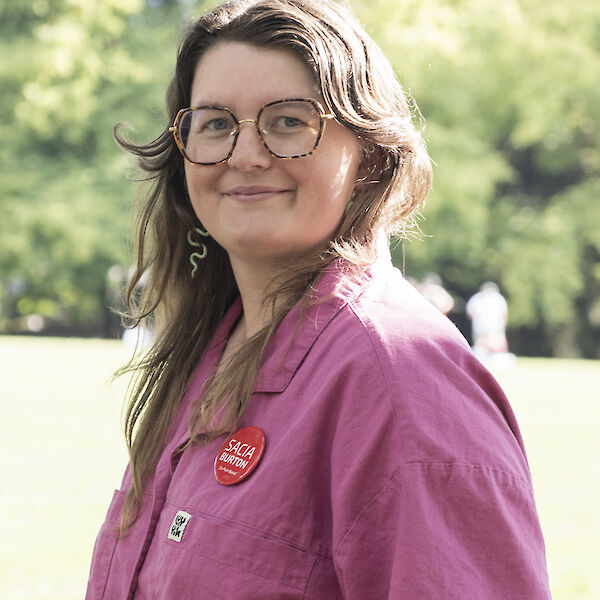
Sacia Burton

Sacia Burton

Park Board · Vancouver
Vancouver 4 yrs

About

As a policy advocate & organizer, I have fought for housing to be treated as a human right, for fairer access to public transit, & for evidence-based approaches to climate change mitigation. I am ready to champion equity, affordability, and climate.

Policy commitments

Buildings

We all want healthy, affordable, and comfortable homes. These policies will help to lower energy bills, cut pollution, and improve indoor air quality.

✓ Support electrification of new buildings. Supportive
✓ Incentivize electric heat pumps and air filtration systems. Supportive
✓ Scale up energy retrofits for existing homes, businesses, and public buildings. Supportive
✓ Implement a 'right to cool' bylaw to protect tenants during extreme heat events. Supportive
Climate Justice

Our community is already experiencing the harmful impacts of climate change caused by fossil fuel pollution, and taxpayers are on the hook to upgrade and repair critical infrastructure.

✓ Pursue available legal options to recover a fair share of the climate costs facing our community from fossil fuel companies and other big polluters. Supportive
✓ Collaborate with Indigenous peoples as partners in the stewardship of the land, air, and water, and work towards reconciliation. Supportive
Ecosystems

The air we breathe, the water we drink, and the food we eat all rely on healthy ecosystems. Nature can also help protect our community from extreme weather by controlling floods, protecting shorelines, and cooling neighbourhoods. Access to nature improves the health and well-being of residents, and supports biodiversity.

✓ Expand and protect tree canopy, parks, and green infrastructure to cool neighbourhoods, clean air, and manage stormwater. Supportive
✓ Prioritize native tree planting in all areas, especially those with low tree cover, higher population densities, and more vulnerable residents. Supportive
✓ Create connected urban greenways for people and wildlife. Supportive
Land Use

We envision vibrant, walkable communities that protect nature and improve food security.

✓ Build affordable homes near jobs, schools, shops, and transit. Supportive
✓ Upgrade critical infrastructure for heat, fire, flood, and storm resilience. Supportive
✓ Increase food security by supporting local agriculture and community gardens. Supportive
Transport

Connecting neighbourhoods through public transit and active transportation networks will cut pollution, improve public health, and make our communities more affordable (and fun!).

✓ Deliver reliable, frequent, affordable local transit. Supportive
✓ Advocate to improve regional public transit between communities. Supportive
✓ Build bike and roll networks that are safe for everyone. Supportive
Zero Waste

Zero waste policies reduce pollution, keep waste out of landfills, build resilient local economies, and safeguard public health by shifting society away from a disposable culture toward a sustainable circular economy.

✓ Support the development of a circular economy to eliminate waste and improve resilience. Supportive
✓ Implement bylaws to eliminate waste from new buildings, renovation, and demolition projects and to use existing buildings as efficiently as possible. Supportive
✓ Supportive
~ Neutral
× Opposed
– No response

Climate action

How have you contributed to climate action in your community through advocacy, past work, advisory committees, volunteer work, and/or reducing your personal carbon footprint?
I am proud to have advocated consistently for investment in a climate safe future during my time working with the BC Poverty Reduction Coalition. I have presented the BC Climate Emergency Campaign’s report to the Minister for Energy and Climate Solutions for the last two years, wherein colleagues and I have called out the provincial government's unwillingness to meaningfully invest in evidence-based climate mitigation efforts. My advocacy work with BCPRC took aim at every level of Canadian government to ensure that leaders at every level are using all available tools to tackle the climate crisis. I have pushed for systemic solutions, such as greater investment in public transit and taxation of corporations, over consumer-based solutions.

My advocacy has extended into my personal life through participation in sit-ins, art projects, workshops, and ongoing learning, and has informed my transportation and consumption habits. I have been invested in this work for nearly 20 years, and recognize climate advocacy as generational work that we cannot afford to get wrong.

Questions for Vancouver

What is your position on gas hookups for new buildings?
It’s a hard no. We cannot afford to build towards an energy future that, for the sake of our climate, must be made obsolete. By integrating gas hookups in new builds we run the risk of doubling construction costs by tacking on the required retrofit down the road. Let’s get it right the first time.
Will you vote to restore full funding for the Sustainability Office? In your view, what is the role of the Sustainability Office?
Although the Park Board is not directly involved in voting for the funding of the sustainability office, I would be loudly supportive of the Office’s return. This cut will continue to have ripple effects in Vancouver, and it’s critical that the city corrects course to rebuild the continuity of work done by the Sustainability Office. Between the work to be done in both the built and natural environments, the Sustainability Office is a necessary hub for coordinating best practices.
What is your view on a moratorium on AI data centres, given the natural resources they require?
AI data centres don’t belong in our city – or frankly, anywhere else. This runaway tech boom is having demonstrably negative impacts on our ecosystems, our waterways, and our capacity for critical thinking. In order to entertain the idea of AI data centers as a worthwhile investment and tradeoff for use of public resources, there would need to be serious evidence to suggest that the value outweighs the harm. At this time, that evidence is not available.
Given the “controversy” of the Villages Plan, how do you envision accommodating the population growth of the City while dealing with the impacts of climate change?
As our city continues to densify, with families living in smaller homes, more people are coming to rely on Vancouver’s parks as our communal backyards and our community centers as shared living spaces. Unfortunately, consecutive local governments have let real estate developers off the hook for the contributions they are meant to pay into maintaining our parks and public spaces, thus leaving our parks and especially our community centers in critical need of repair. Moving forward, both the Park Board and City Council must be stronger negotiators on behalf of all public space users.

Residents in neighbourhoods all across the city should be able to access the amenities they need to live a full and enjoyable life within reasonable walking distance. Just as my colleagues on Council will work towards that goal through zoning and development approvals, COPE Park Board Commissioners will work to improve the accessibility and availability of public spaces.
What is your plan to create climate safeguards for all of Vancouver’s inhabitants, including the unhoused population?
It is crucial that the incoming local government takes climate mitigation seriously. Spaces managed by Park Board, particularly parks and community centers, are often the last bastion of refuge during unsafe conditions – both for housed and unhoused neighbours. To ensure immediate public safety and well-being during crises, community centers should be adequately equipped to act as cooling and warming centers, have staff on hand to connect people to additional community resources, and offer extended hours during times when it is unsafe to be outdoors for prolonged periods.

In the community centers, rinks, pools, and fieldhouses that Park Board jointly operates, there are both opportunities and responsibilities to ensure heating and cooling is done without fossil fuels; that low-carbon options are prioritized for repairs and construction projects; and that alternative energy production projects (such as the solar panels on Creekside Community Center’s roof) are explored and expedited.

Further, the maintenance of the seawall and living shorelines will be a critical space for investment in the coming years as we navigate sea level rise. Similarly, we must ensure that the urban tree canopy strategy is planting climate resilient species that have higher drought tolerance, and that work to expand the shade canopy is prioritized in the DTES and neighbourhoods that now regularly experience heat island conditions in the summer.

Campaign contributions

Public records from Elections BC — 4 contributions totalling $2,380.63.

2017 NANAIMO BY-ELECTION

4 contributions · $2,380.63

Contributor Date Amount Office Jurisdiction
SACIA BURTON Jul 8, 2017 $1,680.63 COUNCILLOR NANAIMO
IAN GARTSHORE Jun 12, 2017 $100.00 COUNCILLOR NANAIMO
MARJORIE STEWART Jun 27, 2017 $500.00 COUNCILLOR NANAIMO
HUGH THORBURN Jun 20, 2017 $100.00 COUNCILLOR NANAIMO

Compiled & presented by

Authorized by Doctors for Planetary Health - West Coast, registered sponsor under LECFA, doctors4planetaryhealth@gmail.com


Vote4Tomorrow is an independent voter guide to evaluate where local candidates stand on climate and environmental policies that will affect our future.

© 2026 Vote4Tomorrow