
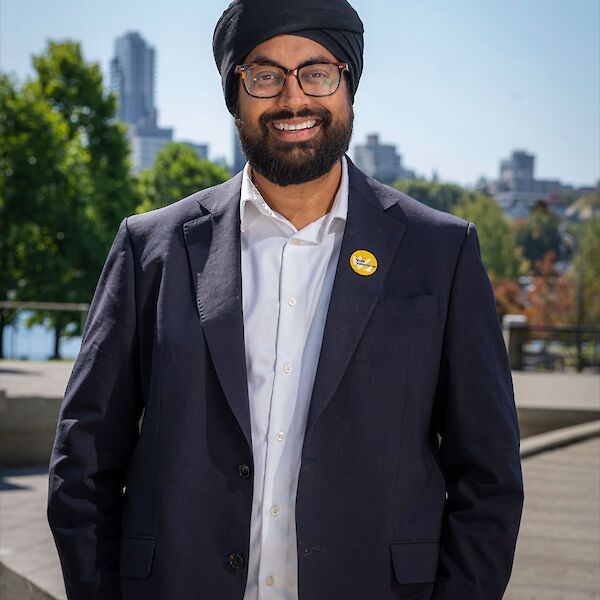
Keerit Jutla
About
Policy commitments
We all want healthy, affordable, and comfortable homes. These policies will help to lower energy bills, cut pollution, and improve indoor air quality.
Our community is already experiencing the harmful impacts of climate change caused by fossil fuel pollution, and taxpayers are on the hook to upgrade and repair critical infrastructure.
The air we breathe, the water we drink, and the food we eat all rely on healthy ecosystems. Nature can also help protect our community from extreme weather by controlling floods, protecting shorelines, and cooling neighbourhoods. Access to nature improves the health and well-being of residents, and supports biodiversity.
We envision vibrant, walkable communities that protect nature and improve food security.
Connecting neighbourhoods through public transit and active transportation networks will cut pollution, improve public health, and make our communities more affordable (and fun!).
Zero waste policies reduce pollution, keep waste out of landfills, build resilient local economies, and safeguard public health by shifting society away from a disposable culture toward a sustainable circular economy.
Climate action
The biggest lesson I have learned is to ask why we are developing something, not just whether we can.
Canada needs investment, minerals, energy and economic growth. But if we are going to extract resources and create wealth, we also need to ask what that prosperity is building: healthier communities, resilient infrastructure, environmental stewardship and long-term economic security.
That is why my approach to climate action is not ideological. It is about people and planet together. I also believe sustainability requires personal responsibility. I have changed my own habits around consumption, health and diet because sometimes sustainability means changing what we do, not simply asking someone else to change.
Climate action works when economic development, affordability and environmental responsibility reinforce one another.
Questions for Vancouver
My test is straightforward: Does it materially improve affordability? Does it speed up construction? Is it necessary? Who benefits? And what does the evidence say?
When City staff examined allowing gas for heating and hot water in new construction, they concluded it was not expected to improve affordability or accelerate housing approvals compared with the low-carbon option, while buildings choosing the gas pathway would produce significantly higher emissions. That evidence matters.
I support reviewing regulations that add unnecessary cost, duplication or delay. In fact, Council is currently undertaking that broader review. But affordability should be demonstrated, not simply asserted. The current Vancouver Building By-law also remains in force while that review continues.
So my position is simple: remove regulations that do not produce a meaningful public benefit, while maintaining lower-carbon standards.
Vote Vancouver has specifically committed to reinstating Energize Vancouver and pursuing practical measures that reduce building emissions, improve energy performance and strengthen climate resilience. I support funding the capacity necessary to deliver that work.
What I would not do is commit blindly to recreating every historic budget line without looking at the current mandate, staffing and outcomes. The purpose matters more than the organizational chart. A potential Sustainability Office should provide technical expertise, track emissions and climate risk, help improve building performance, coordinate adaptation to heat and wildfire smoke, and make sure climate considerations are integrated into infrastructure and planning.
That work should be ambitious, properly funded and measurable.
But I do not think the choice is simply “AI everywhere” or “ban AI.”
I would ask: What public value is being created? What resources does the project consume? What lasting jobs and economic activity does it create? What infrastructure does it displace? And what safeguards are required?
Technology should serve people, not become an end in itself.
I therefore support rigorous standards for major data centres and project-by-project evaluation rather than an automatic approval or a permanent blanket prohibition.
If evidence showed that a temporary pause was needed while appropriate energy, water, land-use or environmental standards were established, I would consider that evidence.
The question should always be: why are we building it, and does the public benefit justify the resources it consumes?
What the Villages Plan controversy demonstrated is that how you make decisions matters almost as much as what you decide.
There was public engagement on the Villages program, including open houses and surveys, and hundreds of speakers ultimately registered for the July 2026 public hearing. Council nevertheless rejected the Plan.
That tells me there was a trust problem that the process did not resolve.
My professional background is in consultation and consent-based development. Consultation cannot just mean presenting people with a largely completed decision and asking for reaction. Good engagement begins early, explains the constraints honestly and demonstrates how community input affected the result.
At the same time, consultation cannot mean that nothing ever changes.
The city is growing. We need homes, including homes for middle-income people, and Vote Vancouver’s platform specifically commits to building complete neighbourhoods with childcare, schools, public space, healthcare and community services rather than simply counting housing units.
Climate needs to be integrated into that growth: more walkable complete neighbourhoods, better access to transit, energy-efficient buildings, mature-tree protection and infrastructure that reduces unnecessary travel.
No neighbourhood or interest group will get 100 per cent of what it wants. The government's job is to create a transparent process, listen seriously, make the trade-offs clear and then make decisions.
Growth should happen with communities and for residents, not simply to them.
People experiencing homelessness face the most immediate risk from extreme heat, wildfire smoke, cold and severe weather because they often have nowhere safe to go.
So the first principle is dignity.
Second, we need to use the infrastructure Vancouver already has. Libraries, community centres, pools and other civic facilities can function as neighbourhood resilience hubs during extreme weather. Vote Vancouver has committed to investing in those public facilities.
Third, housing itself needs to be climate resilient. Supportive housing and SRO replacement should consider cooling, ventilation, air filtration, severe weather and access to community services, not simply whether someone has been placed inside four walls. Vote Vancouver’s housing platform commits to replacing unsafe SROs with dignified supportive housing.
Fourth, neighbourhood design matters. Mature trees provide shade and help manage stormwater, which is why the platform commits to maintaining Vancouver’s 30 per cent tree-canopy target while separately tracking mature trees and new plantings.
And finally, Vancouver has to work constructively with the Province, federal government, First Nations and neighbouring municipalities. Many of the largest climate, housing and health tools sit outside municipal jurisdiction.
My framework is simple: prevention, resilience and dignity.
Reduce emissions where Vancouver can make a meaningful difference. Prepare our infrastructure for the climate conditions we know we are facing. And make sure climate protection is available to everyone, including someone who does not have a front door to close.
Compiled & presented by

Vote4Tomorrow is an independent voter guide to evaluate where local candidates stand on climate and environmental policies that will affect our future.