
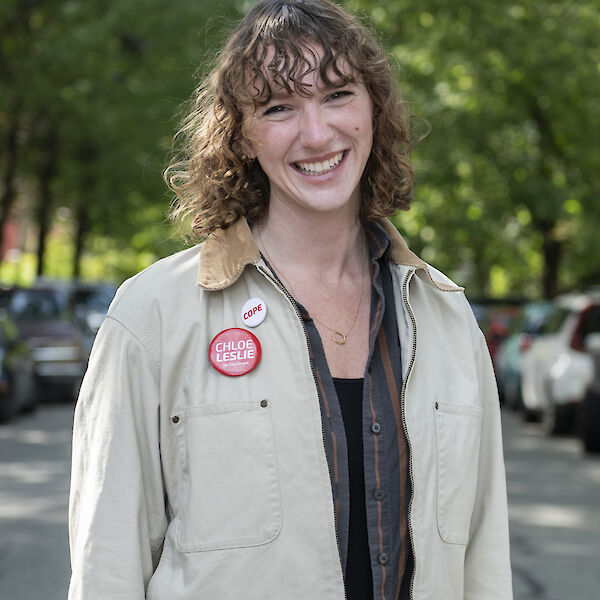
Chloe Leslie
About
Policy commitments
We all want healthy, affordable, and comfortable homes. These policies will help to lower energy bills, cut pollution, and improve indoor air quality.
Our community is already experiencing the harmful impacts of climate change caused by fossil fuel pollution, and taxpayers are on the hook to upgrade and repair critical infrastructure.
The air we breathe, the water we drink, and the food we eat all rely on healthy ecosystems. Nature can also help protect our community from extreme weather by controlling floods, protecting shorelines, and cooling neighbourhoods. Access to nature improves the health and well-being of residents, and supports biodiversity.
We envision vibrant, walkable communities that protect nature and improve food security.
Connecting neighbourhoods through public transit and active transportation networks will cut pollution, improve public health, and make our communities more affordable (and fun!).
Zero waste policies reduce pollution, keep waste out of landfills, build resilient local economies, and safeguard public health by shifting society away from a disposable culture toward a sustainable circular economy.
Climate action
For four years, I worked with Vancouver Food Runners, helping build and manage a network of businesses and community organizations that recovered more than 1.2 million pounds of surplus food annually. By keeping good food out of the waste stream and redirecting it to people who needed it, this work mitigated approximately 2.35 million pounds of CO₂ equivalent each year while addressing food insecurity across Vancouver.
I have also worked with BC Green Business, supporting local businesses to reduce their environmental impact and meet their sustainability goals. This included conducting sustainability and retrofit assessments, identifying opportunities to improve energy and water efficiency, reduce waste, strengthen recycling and composting practices, and make operations more sustainable and cost-effective.
These experiences have shaped how I approach climate action. I believe the transition to a low-carbon city needs to be practical, equitable, and accessible to everyone. Climate policy should not download costs onto workers and small businesses. We should use public investment, incentives, and strong standards to help communities reduce emissions while lowering costs and creating good green jobs.
My work has shown me that ambitious climate action can also reduce waste, improve affordability, support local businesses, and build a more resilient city.
Questions for Vancouver
COPE has been consistent on this. Councillor Sean Orr opposed the ABC majority’s 2026 motion that opened the door to reversing Vancouver’s previous restrictions on gas heating in new construction. That decision put Vancouver’s progress toward zero-emissions buildings at risk and moved us in the wrong direction on climate action.
We should be building for the future, not locking new buildings into fossil-fuel infrastructure that will last for decades. I support maintaining strong zero-emissions standards for new construction while ensuring the transition is affordable and supported by investments that help residents, workers, and local businesses move toward cleaner, more efficient energy.
The City has described its sustainability team’s role as providing advice, research, and project leadership to achieve Vancouver’s climate goals, while leading climate action across both the community and City operations.
I see its role as making sure climate action is embedded across City Hall, from buildings and transportation to land-use planning and infrastructure, and ensuring we track progress and remain accountable to our climate targets.
We cannot declare a climate emergency and then cut the staff responsible for delivering the response.
COPE opposes the creation and operation of large scale data centers for Artificial Intelligence in Vancouver.
COPE opposes corporations using “AI” to push a privatization agenda, and stands for freedom of information, and a public internet.
COPE opposes the integration of AI large language models in schools.
COPE opposes the use of automation and AI to lay off workers and undermine labour rights.
The Villages Plan proposed needed density, but without strong enough protections for tenants facing displacement, adequate community-led planning, or sufficient alignment between growth and existing transit infrastructure. If new development displaces lower-income tenants and pushes people farther from jobs, services, and transit, we risk increasing car dependence while making the affordability crisis worse.
I support climate-resilient density with strong anti-displacement protections. That means protecting existing affordable rental housing, ensuring tenants have meaningful rights and protections when redevelopment occurs, and concentrating growth alongside the transit, public services, green space, and amenities needed to support it.
We can accommodate population growth while cutting emissions and adapting to climate change. But density alone isn’t climate policy. We need to build complete, transit-connected communities without displacing the people who already call them home.
COPE will restore funding for cooling kits and invest equitably in community centres so every neighbourhood has safe, accessible spaces during climate emergencies. We’ll also expand Vancouver’s tree canopy, prioritizing East and South Vancouver and other neighbourhoods with less shade and greater exposure to extreme heat.
But the most important climate safeguard is a safe, stable, climate-resilient home. We will fight for 20,000 new affordable homes, including supportive and shelter-rate housing, while supporting retrofits of older rental buildings and SROs so residents aren’t left in dangerous conditions during heat waves.
We also need long-term adaptation, including green infrastructure, flood protection, expanded tree canopy, and cooling infrastructure across the city.
Climate safety cannot depend on your income, postal code, or whether you have a roof over your head.
Compiled & presented by

Vote4Tomorrow is an independent voter guide to evaluate where local candidates stand on climate and environmental policies that will affect our future.