
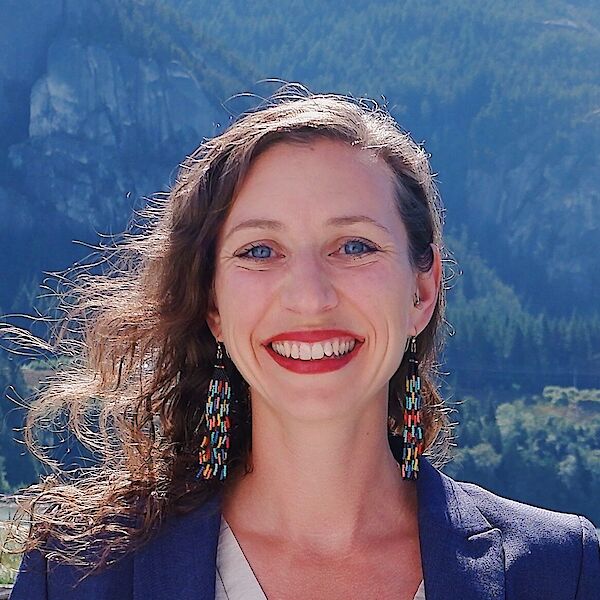
Jenna Stoner
- Neighbourhood:
- Brackendale
- Years in the community:
- 12
About
Policy commitments
We all want healthy, affordable, and comfortable homes. These policies will help to lower energy bills, cut pollution, and improve indoor air quality.
Our community is already experiencing the harmful impacts of climate change caused by fossil fuel pollution, and taxpayers are on the hook to upgrade and repair critical infrastructure.
The air we breathe, the water we drink, and the food we eat all rely on healthy ecosystems. Nature can also help protect our community from extreme weather by controlling floods, protecting shorelines, and cooling neighbourhoods. Access to nature improves the health and well-being of residents, and supports biodiversity.
We envision vibrant, walkable communities that protect nature and improve food security.
Connecting neighbourhoods through public transit and active transportation networks will cut pollution, improve public health, and make our communities more affordable (and fun!).
Climate change, increasing populations, and overconsumption threaten our water security. Healthy watersheds and forests are critical to support clean drinking water, stormwater management, climate resilience, and biodiversity for future generations.
Zero waste policies reduce pollution, keep waste out of landfills, build resilient local economies, and safeguard public health by shifting society away from a disposable culture toward a sustainable circular economy.
Climate action
* That motion lead to development of our Community Climate Action Plan and creation of the District's sustainability department.
* Long and active supporter of local food systems through Squamish Food Policy, school farm program, and Squamish CAN's school meal program and the Harvest Hub.
* Installed a landfill gas capture system that collects 75% of methane and accounted for 24% of our 2030 emissions reduction target.
* Supported the creation of a deconstruction bylaw that requires diversion of at least 80% of all demolition projects
* Continued support for improving safety and equity for all road users by expanding options for pedestrians, cyclists, buses, and cars.
* Worked with council, staff, and businesses to centre the Circular Economy as a core tenant of our local economic development plans.
* Supported Squamish adopting the highest level of the BC Zero Carbon Step Code so that new buildings can achieve low-emissions in ways that work for them.
* Actively working to electrify the District's vehicle fleet and ensure new municipal buildings are designed to be climate resilient and low-emissions.
* I have been a member of Climate Caucus since its inception in 2019, working with elected officials across the province to share resources, ideas, and work together to tackle climate change at the local level.
Questions for Squamish
Council's job is to protect Squamish's financial future, and if elected Mayor I will keep insisting on terms — or on standard taxation — that actually reflect what this community needs. It's impossible to state what a mill rate will be in future years as this is determined based on annual budget needs of the municipality. It is also important to note that the mill rate is not set for a specific company or land owner, it is set for a tax class (in this case WLNG is part of the Class 4 - Major Industry tax class) and mill rates can have significant impact on a community's ability to attract new business, so setting mill rates needs to be done based on strong budgeting principles and in the context of a clear economic development strategy.
Garibaldi at Squamish: I am generally not supportive of this proposal. The proposal has been around since the '60s, has had many evolutions and I'm not familiar with the current proposal. The project is outside of Squamish's municipal boundary and would require an extension of our municipal boundary to Brohm Ridge to advance it, which goes against many of the core policies in the Official Community Plan and could have significant financial implications and risk.
Cheema Lands: I have not been supportive to date. Future discussions of these lands - and others on the periphery of the GMB - should be addressed through an update of the OCP.
North Crumpit: This project is inside our GMB and I have been supportive of the neighbourhood planning process for this proposed development.
Squamish has strong plans in place for ensuring all major infrastructure projects are built with an eye to climate resiliency and I commit to continuing that approach. Some examples include:
- Firehall #1 and Emergency Operations Centre was built up and out of the flood plain.
- We paused and redesigned the new Public Works Facility so that it would adhere to flood construction level, because this critical building needs to withstand future emergencies.
- Invest annually in diking infrastructure as per the 2017 Flood Hazard Management Plan
- Updated our Community Wildfire Resilience Plan in 2026
- Support to the library and Brennan Park (when needed) to act as cooling centres and/or clean air centres during times of extreme heat and smokey skies.
Going forward I look forward to:
- Updating our multi-modal evacuation plan
- hold firm on hazard policies so new development steers away from high-risk areas
- partner and advocate with Province, Feds, and Squamish Nation to support this work so local tax payers don't carry these costs alone.
That relationship has grown step by step. In 2018 the District endorsed the UN Declaration on the Rights of Indigenous Peoples. In 2019 the two governments signed a Community Forest governance agreement. The Squamish Strong Protocol Agreement followed in 2023. In 2025 came a Memorandum of Understanding that affirms a government-to-government relationship on land stewardship, reconciliation and shared decision-making. The two governments have also worked together on flood protection, emergency planning and emergency response (such as through the Dryden Creek wildfire in 2025).
The MOU is not legally binding, so its strength depends on good faith. I will honour its commitments and continue to do the work that charts a path forward that will honour and respect that the Sḵwx̱wú7mesh Úxwumixw have been stewards of these lands, air, and water since time immemorial, while also recognizing the fact that none of us are going anywhere and we need to work together to make Squamish a place we are all proud to call home.
Campaign contributions
Public records from Elections BC — 22 contributions totalling $4,279.00.
2022 GENERAL LOCAL ELECTIONS
13 contributions · $2,215.00
| Contributor | Date | Amount | Office | Jurisdiction |
|---|---|---|---|---|
| CLAIRE ANDREWS | Sep 24, 2022 | $100.00 | COUNCILLOR | SQUAMISH |
| CAROLINE CARTER | Oct 4, 2022 | $250.00 | COUNCILLOR | SQUAMISH |
| TRISHA CHORNYJ | Sep 20, 2022 | $125.00 | COUNCILLOR | SQUAMISH |
| ELIJAH DANN | Oct 8, 2022 | $250.00 | COUNCILLOR | SQUAMISH |
| LAURA DUPONT | Sep 16, 2022 | $100.00 | COUNCILLOR | SQUAMISH |
| REGAN KOHLHART | Sep 24, 2022 | $150.00 | COUNCILLOR | SQUAMISH |
| BRENT MCMURTRY | Sep 20, 2022 | $150.00 | COUNCILLOR | SQUAMISH |
| CHRIS MURRELL | Sep 18, 2022 | $100.00 | COUNCILLOR | SQUAMISH |
| KARA PITMAN | Sep 29, 2022 | $100.00 | COUNCILLOR | SQUAMISH |
| SARAH REID | Sep 20, 2022 | $140.00 | COUNCILLOR | SQUAMISH |
| LAURIE SPEAR | Sep 19, 2022 | $250.00 | COUNCILLOR | SQUAMISH |
| JENNA STONER | Sep 10, 2022 | $300.00 | COUNCILLOR | SQUAMISH |
| BENJAMIN STONER | Sep 10, 2022 | $200.00 | COUNCILLOR | SQUAMISH |
2018 GENERAL LOCAL ELECTIONS
9 contributions · $2,064.00
| Contributor | Date | Amount | Office | Jurisdiction |
|---|---|---|---|---|
| JOHN CHAPMAN | Oct 2, 2018 | $100.00 | COUNCILLOR | SQUAMISH |
| ELIJAH DANN | Oct 17, 2018 | $200.00 | COUNCILLOR | SQUAMISH |
| MICHALINA HUNTER | Oct 8, 2018 | $250.00 | COUNCILLOR | SQUAMISH |
| BARBARA MCDONALD | Oct 17, 2018 | $300.00 | COUNCILLOR | SQUAMISH |
| TED PRIOR | Oct 5, 2018 | $240.00 | COUNCILLOR | SQUAMISH |
| TED PRIOR | Sep 24, 2018 | $100.00 | COUNCILLOR | SQUAMISH |
| LAURIE SPEAR | Sep 27, 2018 | $250.00 | COUNCILLOR | SQUAMISH |
| JENNA STONER | Sep 26, 2018 | $400.00 | COUNCILLOR | SQUAMISH |
| MATT WELSH | Oct 1, 2018 | $224.00 | COUNCILLOR | SQUAMISH |
Compiled & presented by

Vote4Tomorrow is an independent voter guide to evaluate where local candidates stand on climate and environmental policies that will affect our future.