
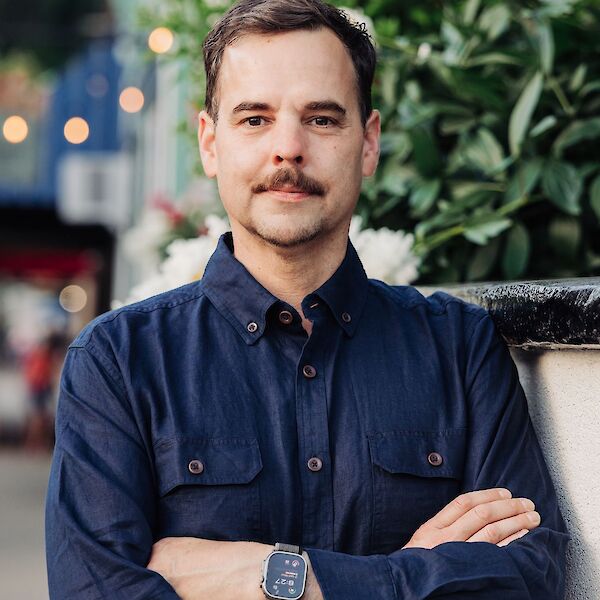
Aaron Orlando
About
Policy commitments
We all want healthy, affordable, and comfortable homes. These policies will help to lower energy bills, cut pollution, and improve indoor air quality.
Our community is already experiencing the harmful impacts of climate change caused by fossil fuel pollution, and taxpayers are on the hook to upgrade and repair critical infrastructure.
The air we breathe, the water we drink, and the food we eat all rely on healthy ecosystems. Nature can also help protect our community from extreme weather by controlling floods, protecting shorelines, and cooling neighbourhoods. Access to nature improves the health and well-being of residents, and supports biodiversity.
We envision vibrant, walkable communities that protect nature and improve food security.
Connecting neighbourhoods through public transit and active transportation networks will cut pollution, improve public health, and make our communities more affordable (and fun!).
Climate change, increasing populations, and overconsumption threaten our water security. Healthy watersheds and forests are critical to support clean drinking water, stormwater management, climate resilience, and biodiversity for future generations.
Zero waste policies reduce pollution, keep waste out of landfills, build resilient local economies, and safeguard public health by shifting society away from a disposable culture toward a sustainable circular economy.
Climate action
Waste is a good example. Revelstoke is moving toward separated residential organics collection in 2027. Keeping organics out of the landfill reduces methane emissions and is one of the more significant opportunities for reducing our community emissions.
Long before joining council, I also worked as a local journalist and reported on environmental issues in Revelstoke, including problems with our wastewater treatment system, odour and effluent. I’m pleased that after years of work we are now completing a major upgrade of that system near the end of 2026.
Transportation is another big piece. I have supported expansion of our local bus service, better routes and efforts to increase ridership, along with investments in multi-use pathways and active transportation. I bike regularly myself, including commuting around town, and want cycling and walking to be realistic, safe transportation choices for riders of all abilities.
There is more coming. I want to continue work on active transportation connections, increased transit ridership, water conservation, waste diversion, infrastructure resilience and other initiatives already moving through Revelstoke’s planning process.
Climate action at the municipal level is often pretty practical. Some of the biggest GHG reductions come from less glamorous things, like what goes into the landfill, how we treat wastewater, how efficiently we use water, how people get around town, and how we plan and renew infrastructure.
Questions for Revelstoke
Water has become a bigger issue. After the drought conditions of 2023, we introduced a four-stage water restriction system. The water metering program should eventually give us much better information about consumption and leakage, but it needs to be implemented fairly and communicated properly.
On land use, our OCP already identifies environmentally sensitive and hazardous areas. As Revelstoke grows, we need to use those tools, protect important natural areas and wildlife corridors, and concentrate development where infrastructure already exists.
There are also smaller practical things that add up: community gardens and local food production, Bear Smart work, planting climate-resilient trees, improving drainage and stormwater systems, and protecting and expanding our parks and green spaces.
A lot of climate adaptation isn’t particularly glamorous. It is maintaining infrastructure, managing forests, conserving water, protecting natural areas and making good land-use decisions now so we aren’t dealing with much larger problems later.
I served a term on the Revelstoke Community Forest Corporation board and saw first-hand the work RCFC does beyond harvesting, including its involvement in caribou conservation and support for community initiatives. I strongly support Revelstoke remaining a harvesting and milling community with a sustainable forest industry that creates local jobs and value, rather than simply exporting raw logs with little local benefit. RCFC is a key player in the success of the local milling sector and it also gives back millions to city initiatives.
I also feel RCFC sometimes gets unfairly caught in the crossfire over forestry issues that are largely outside its control. Many of the major regulatory decisions involving forestry, old growth, biodiversity and endangered wildlife habitat are provincial responsibilities. Where change requires provincial action, that is where advocacy should be directed.
I think we can support a sustainable local forestry industry while continuing to improve environmental practices and having an open community discussion about how our community forest is managed.
Our OCP identifies Indigenous reconciliation as an ongoing responsibility, and the city has been working to improve communication and collaboration with Indigenous communities. Our Heritage Management Plan also identifies opportunities around culturally important places, Indigenous place names, heritage projects and cultural awareness.
I have tried to participate personally as well. I attend the annual Truth and Reconciliation gathering. Through council assignments, I have also liaised with the Indigenous Friendship Society of Revelstoke and have seen the important work they do locally. I think the Friendship Society should continue to be an important partner for the city.
Revelstoke is also in a somewhat unusual position because there is no First Nation government physically located in the community, while several Nations have important historical and continuing connections to this area. That makes maintaining relationships beyond our municipal boundaries particularly important.
I would like to see more regular communication rather than engagement occurring mainly when a particular issue comes up. There are also opportunities for joint grant applications, regional collaboration on land-use, heritage and environmental projects, and greater visibility for Indigenous history and culture in the community.
For me, reconciliation at the municipal level is largely about building and maintaining those relationships over time and finding practical opportunities to work together.
Revelstoke has actually built a strong foundation over many years. Council adopted the Food Charter, supported the Food Security Strategy, and helped establish the Food Security Coordinator. More recently, the City provided land for the Food Commons partnership between the Local Food Initiative and Indigenous Friendship Society.
That partnership approach is working. LFI now operates several community growing spaces, year-round markets and education programs. The new Food Commons includes community gardens and a demonstration farm, while Community Connections operates the food bank and community kitchen. There is also new work connecting local food directly to people who need it, including local food procurement for the food bank and a winter market nutrition coupon pilot.
I want the city to keep strengthening that network and focus on where it can have the greatest effect: land-use decisions that protect opportunities to grow food, access to city land where appropriate, grants and outside funding, infrastructure, and making it easier for local producers and organizations to work together.
The goal should be sustainable systems, not one-off programs. In a community that still imports the vast majority of its food, we aren’t going to become self-sufficient, but we can increase local production, reduce waste, support producers and make sure more locally produced food reaches local families.
I lived through 2017, when we saw far too many bears killed in Revelstoke. We have made progress since then, but there are still a few important steps to take. My goal next term is for Revelstoke to achieve Bear Smart Community status.
I have had conversations with our Bear Aware coordinator this year and want to continue moving that agenda forward. In the past month I’ve had conversations with city staff, Bear Aware and Wildsight about practical tree programs. Council has recently given direction to prepare a report to remove problematic fruit trees from city parks, and I want to see replacement-tree programs available to residents as part of a broader effort to reduce attractants.
We need to keep improving garbage and attractant management and ensure our bylaws can be enforced. Today, at the Public Infrastructure Committee meeting, we reviewed bear proof bin options to be implemented in 2027 in conjunction with new trucks.
I want to pursue additional seasonal enforcement capacity for bears.
The goal is to reduce human-bear conflicts and, ultimately, reduce the number of bears that are destroyed. If bears are part of Revelstoke’s identity, our investment in coexistence should reflect that.
Today I am council’s representative on the Revelstoke Community Housing Society. I have been directly involved in building the team, organization and committee responsible for the new Downie Street development, and I spend hours each week on the project. I am really proud of the RCHS team delivering 166 rental homes and a childcare centre. I also served on RCHS during my previous council term, including lobbying the housing minister for support, which was the genesis of the Downie Street development. Housing is one concrete way we can manage resort pressures.
But sustainable tourism is broader than housing. Tourism needs to contribute to the infrastructure and services it relies on. I support continuing to use tourism revenues and partnerships for parks, recreation, trails, transit and community amenities that residents use too. We also need to manage short-term rentals, traffic and parking pressures, protect access to the places residents value, and make sure growth doesn’t overwhelm infrastructure.
Revelstoke isn’t just a destination. It is first a community where people live and raise families. My approach is not to oppose tourism growth, but to make sure we capture its benefits and continually reinvest them in housing, infrastructure, climate resilience and quality of life for the people who live here.
Campaign contributions
Public records from Elections BC — 4 contributions totalling $1,003.00.
2022 GENERAL LOCAL ELECTIONS
1 contribution · $453.00
| Contributor | Date | Amount | Office | Jurisdiction |
|---|---|---|---|---|
| AARON PAUL ORLANDO | Dec 9, 2022 | $453.00 | COUNCILLOR | REVELSTOKE |
2014 GENERAL LOCAL ELECTIONS
3 contributions · $550.00
| Contributor | Date | Amount | Office | Jurisdiction |
|---|---|---|---|---|
| AARON P ORLANDO | Oct 2, 2014 | $200.00 | COUNCILLOR | REVELSTOKE |
| AARON P ORLANDO | Nov 6, 2014 | $200.00 | COUNCILLOR | REVELSTOKE |
| AARON P ORLANDO | Oct 22, 2014 | $150.00 | COUNCILLOR | REVELSTOKE |
Compiled & presented by
Vote4Tomorrow is an independent voter guide to evaluate where local candidates stand on climate and environmental policies that will affect our future.