
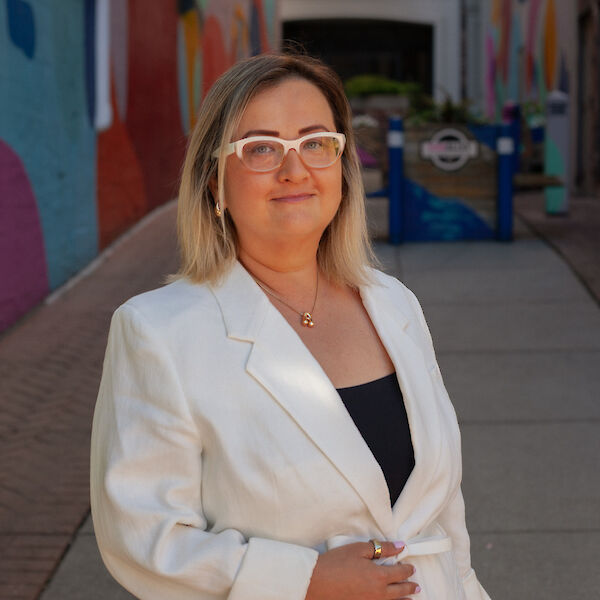
Anna Boltenko
About
Policy commitments
We all want healthy, affordable, and comfortable homes. These policies will help to lower energy bills, cut pollution, and improve indoor air quality.
The air we breathe, the water we drink, and the food we eat all rely on healthy ecosystems. Nature can also help protect our community from extreme weather by controlling floods, protecting shorelines, and cooling neighbourhoods. Access to nature improves the health and well-being of residents, and supports biodiversity.
We envision vibrant, walkable communities that protect nature and improve food security.
Connecting neighbourhoods through public transit and active transportation networks will cut pollution, improve public health, and make our communities more affordable (and fun!).
Zero waste policies reduce pollution, keep waste out of landfills, build resilient local economies, and safeguard public health by shifting society away from a disposable culture toward a sustainable circular economy.
Climate action
For more than a decade, I have supported community gardening, local food security and sustainable neighbourhoods. I managed a community garden, volunteered with the Edible Garden Project and Table Matters Network, and helped connect residents with local food and community resources.
I also served as CEO of a local Electoral District Association for a federal political party that advances climate action at every level of government. I continue to advise and support its candidates in bringing green values and climate urgency into public conversations through workshops, webinars, community events and direct engagement with residents.
Through six years on the City’s Social Planning Advisory Committee and my current work on the Advisory Planning Commission, I have advocated for growth that considers infrastructure, public transit, green space, food security, climate resilience and residents’ quality of life together.
As co-founder of Wonder Wonders Foundation and the North Shore Kids Festival, I support local organizations and businesses, provide environmental learning opportunities for children, and incorporate responsible waste management into large community events.
Personally, I live in a compact, walkable neighbourhood and combine walking, public transit and an electric vehicle.
For me, climate action must be practical and measurable: protecting mature trees, reducing building emissions, expanding clean transportation, strengthening local food systems and preparing infrastructure for heat, flooding and other climate risks.
Questions for North Vancouver (City of)
Within my first year, I would bring forward or support a Council motion requesting that Lonsdale Energy publish its carbon-neutrality roadmap within 12 months. The roadmap should include its current emissions and energy-source baseline; lifecycle emissions for every fuel; capital and operating costs; expected impacts on customer rates; and measurable targets for 2027, 2030, 2040 and 2050.
It should identify specific projects, budgets, timelines and decision points, including sewer-heat recovery, electric boilers, waste-heat recovery, thermal storage, system efficiency and demand reduction. It must also explain how remaining natural gas and RNG use will be phased out.
Publication is only the first step. I would require an annual public progress report comparing actual results with the roadmap, including emissions, energy mix, costs and project delivery. Material delays or target changes should be reported openly to Council and residents, with reasons and corrective actions.
A City-owned utility must lead through transparency, evidence and accountability.
RNG was presented as a transitional measure. It should not become an expensive permanent substitute for genuine system decarbonization. I would oppose new long-term RNG commitments unless Council receives compelling, independently verified evidence that they are necessary for short-term reliability.
The transition should prioritize sewer-heat recovery, electric boilers powered by BC’s low-carbon electricity, recovered heat from buildings and industrial sources, geoexchange, thermal storage, network efficiency and energy-conservation measures. During the transition, RNG should be limited to clearly defined emergency or peak-load needs—not used to claim progress that could be achieved through non-combustion technologies.
I would also require transparent reporting of RNG quantities, suppliers, costs and full lifecycle emissions, including methane leakage and the difference between contractual emission claims and actual local emissions.
Eliminating RNG must be part of a broader plan to reduce both renewable and fossil gas dependence without compromising reliability or placing unreasonable costs on residents.
First, I would insist that the full $235 million Acciona settlement—and any further recoveries, insurance proceeds or savings—be credited directly against the North Shore share of the project, with the resulting household savings reported publicly.
Second, I would work with the District of North Vancouver and West Vancouver to demand that Metro Vancouver reconsider the cost-allocation formula. North Shore residents should not disproportionately carry costs caused by failed regional procurement, oversight and project governance.
Third, I support the requested public inquiry, the independent review now underway, full disclosure of its findings, and clear accountability for the decisions that caused the overruns. I would also advocate jointly to the provincial and federal governments for additional infrastructure funding and financial relief.
Finally, I would require plain-language annual reporting showing the total project cost, debt, interest, remaining risks, household impacts and every action taken to reduce them.
Residents must receive more than explanations. They deserve transparency, regional fairness and every possible dollar of relief.
Applications should begin with a qualified arborist’s inventory and assessment before site layout is finalized. Applicants should demonstrate how healthy mature trees, their root zones and connected habitat will be retained. Staff and Council should have tools to require design changes, including adjustments to setbacks, site coverage, building placement and underground parking, where reasonable.
Where removal is genuinely unavoidable, replacement requirements should be based on lost canopy and ecological value—not simply one small replacement tree for one mature tree. Larger replacement ratios, climate-resilient native species, adequate soil volume, financial securities and multi-year survival monitoring should be required.
I would also support public canopy mapping, neighbourhood-level retention targets, stronger construction protection and penalties that exceed any financial benefit from unauthorized removal.
We can add housing while protecting mature trees, but only if tree retention is built into planning from the beginning. Mature trees provide cooling, stormwater management, cleaner air, habitat and public-health benefits that newly planted saplings may take decades to replace.
A mature tree provides the same cooling, stormwater, air-quality and habitat benefits regardless of the zoning beneath it. Excluding certain properties creates an avoidable gap and makes it harder to meet the City’s canopy and climate-resilience goals.
The bylaw should include reasonable, clearly defined exemptions for dead, hazardous or severely diseased trees; invasive species; emergencies; essential infrastructure; and situations where an arborist confirms that retention is not reasonably possible. Routine professional pruning should remain straightforward.
Permits should be timely and affordable, but removals should require appropriate replacement based on canopy value, suitable planting conditions and follow-up survival monitoring.
A citywide bylaw should protect trees fairly while recognizing safety, accessibility, housing and legitimate property needs. The purpose is not to punish homeowners—it is to treat the urban forest as shared infrastructure essential to the health and resilience of the entire community.
Campaign contributions
Public records from Elections BC — 16 contributions totalling $10,670.00.
2022 GENERAL LOCAL ELECTIONS
7 contributions · $4,620.00
| Contributor | Date | Amount | Office | Jurisdiction |
|---|---|---|---|---|
| LIUDMILA AGEICHEVA | Aug 31, 2022 | $880.00 | COUNCILLOR | NORTH VANCOUVER, CITY OF |
| OLEKSANDRA ALEKSANDROVA | Sep 29, 2022 | $375.00 | COUNCILLOR | NORTH VANCOUVER, CITY OF |
| ELENA ALEXEEVA | Oct 11, 2022 | $550.00 | COUNCILLOR | NORTH VANCOUVER, CITY OF |
| ANNA BOLTENKO | Aug 23, 2022 | $1,565.00 | COUNCILLOR | NORTH VANCOUVER, CITY OF |
| STEPHANIE HAWKINS | Oct 15, 2022 | $100.00 | COUNCILLOR | NORTH VANCOUVER, CITY OF |
| DAVID HUNTER | Aug 24, 2022 | $500.00 | COUNCILLOR | NORTH VANCOUVER, CITY OF |
| VERA REZNIK | Aug 29, 2022 | $650.00 | COUNCILLOR | NORTH VANCOUVER, CITY OF |
2018 GENERAL LOCAL ELECTIONS
9 contributions · $6,050.00
| Contributor | Date | Amount | Office | Jurisdiction |
|---|---|---|---|---|
| LIUDMILA AGEICHEVA | Aug 27, 2018 | $600.00 | COUNCILLOR | NORTH VANCOUVER, CITY OF |
| ANNA BOLTENKO | Aug 17, 2018 | $1,200.00 | COUNCILLOR | NORTH VANCOUVER, CITY OF |
| MEHRAN DADBEH | Oct 1, 2018 | $1,200.00 | COUNCILLOR | NORTH VANCOUVER, CITY OF |
| SAT HARWOOD | Sep 7, 2018 | $300.00 | COUNCILLOR | NORTH VANCOUVER, CITY OF |
| NADYA HOLSON | Sep 25, 2018 | $1,200.00 | COUNCILLOR | NORTH VANCOUVER, CITY OF |
| DAVID HUNTER | Aug 16, 2018 | $1,200.00 | COUNCILLOR | NORTH VANCOUVER, CITY OF |
| ANTON VAN WALRAVEN | Sep 7, 2018 | $100.00 | COUNCILLOR | NORTH VANCOUVER, CITY OF |
| ALISON WATT | Sep 15, 2018 | $100.00 | COUNCILLOR | NORTH VANCOUVER, CITY OF |
| JANET WYNNE-EDWARDS | Sep 27, 2018 | $150.00 | COUNCILLOR | NORTH VANCOUVER, CITY OF |
Compiled & presented by

Vote4Tomorrow is an independent voter guide to evaluate where local candidates stand on climate and environmental policies that will affect our future.